
If you didn’t know Jon Bishop before the pandemic chased everyone out of CalEPA headquarters and into a virtual existence six years ago, the State Water Board’s Chief Deputy Director provided quite the introduction. As he sat in board meetings, addressing his peers and members of the public, his wavy, shoulder-length white hair threatened to fly off in different directions. His colorful Jerry Garcia ties hung limply, if harmlessly askew. His round features, accentuated by wire-rimmed, rectangular glasses, reddened with passion when he leaned into the microphone and forcefully delivered his latest message.
You couldn’t miss him if you wanted to — and you wouldn’t want to. After 41 years with the Water Boards — dating back to a time when “total maximum daily loads” (TMDL) referred to weight limits on box trucks instead of pollution limits — he knows where all the pens and pencils are buried.
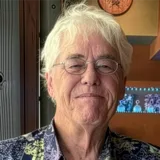
“Things were pretty different when I started in 1984,” he says, laughing. “I even got the first computer they gave employees when I worked for the L.A. Water Board.”
— Jon Bishop
Bishop, who retired last summer after serving the last 18 years in Sacramento, only to return in March as a part-time retired annuitant, has been instrumental in the development of many of the agency’s most impactful projects, including the following:
- The program to investigate the sources of groundwater contamination in drinking water wells in Los Angeles.
- A comprehensive water quality data management system for the Los Angeles Regional Water Quality Control Board.
- The nation’s first urban trash TMDL (limit on amount of pollutant allowed).
- The statewide TMDL for trash flowing into rivers, streams and oceans.
- Key regulations addressing stormwater pollution.
- The Once-Through-Cooling (OTC) policy that established standards to protect marine and estuarine life.
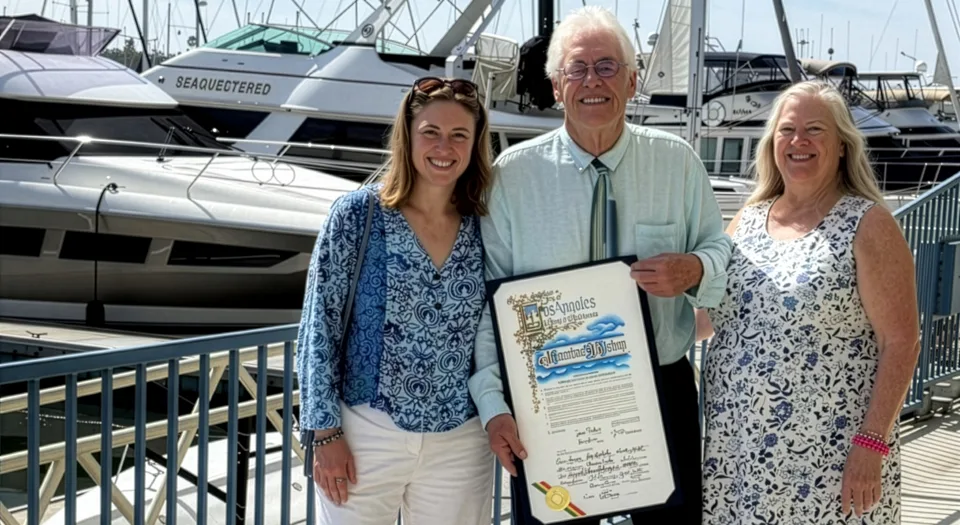
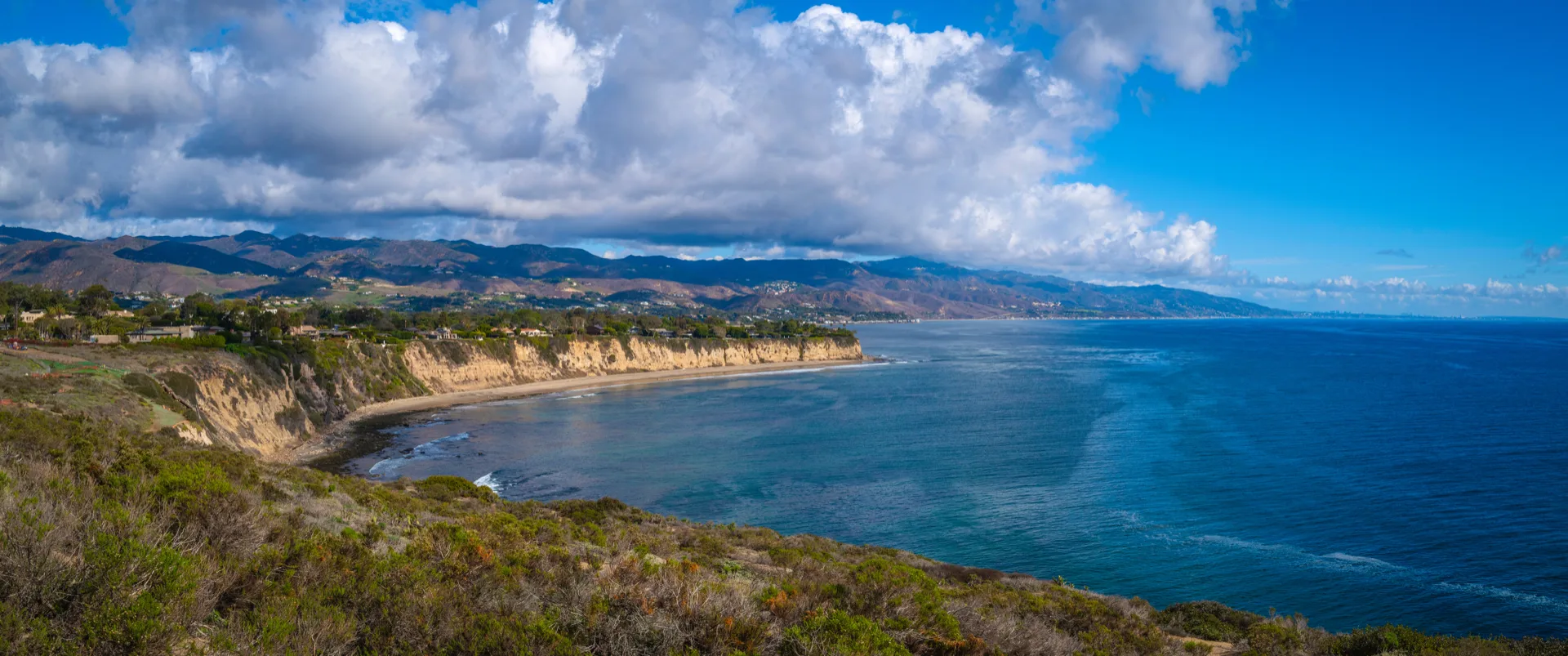
Since its adoption in 2010, the landmark OTC policy has resulted in a decrease of over 2,800 million gallons per day of ocean water that is pumped to cool power plants, reducing marine life mortality significantly. And while Bishop cites his input on the policy as his most memorable accomplishment — he was named 2009 “Ocean Hero” by the Santa Monica Bay Restoration Project for his efforts — there is always another water-related issue to pique his interest.
“Throughout my career, I never really worried about getting a promotion,” he said. “I worried about having a challenge.”
Space stations and NASA help launch a career
That personality trait emerged during his boyhood years in Pasadena. Bored with his studies, he worked as a cook during the day and attended high school at night, doing well enough to enroll in the forestry program at Humboldt State. Ultimately, forestry didn’t excite him, either, so he spent much of his time designing an indoor environment for a space station and pestering NASA experts for an interview.
Those same experts convinced him to change his major to environmental engineering, unknowingly kick-starting his illustrious Water Boards career. While he washed dishes at a local restaurant and looked for jobs after graduation, the mother of a college friend saw a flyer advertising a position with the Los Angeles Water Board and urged him to apply.
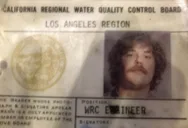
Bishop, a large man with a booming personality, overwhelmed the hiring committee with both his computer modeling skills and his confidence: He was offered the job before changing out of his suit-and-tie. Within days, he was assigned to create mathematical models of groundwater movement and help the permitting section update old waste discharge requirements.
His first major challenge was managing a small unit that tested drinking water supplies and investigated the sources of contamination throughout the Los Angeles basin. That small unit, it turns out, soon expanded to a few dozen employees.
Boots-on-the-ground tactics reveal water pollution sources
“L.A. had the largest number of wells impacted by volatile organic compounds (VOCs),” he recalled during an interview in his 24th floor office. “What caused the contamination? We would take a map book, locate the well, draw a half-mile circle around it, then walk up and down streets to manufacturing sites that did things like plating or metal work. We would ask, ‘What chemicals do you use?’ We found most of the wells were contaminated largely from decades of military activities. So, I handled the EPA contract and worked with the State Water Board to develop procedures for investigating those sites.”
After supervising various other programs for the better part of two decades and serving as the L.A. region’s executive officer his final three years, Bishop joined the State Water Board in 2007 as a chief deputy director, overseeing the Divisions of Water Quality, Financial Assistance, Monitoring and Assessment, and Data Management. While handling the heavy workload, he commuted to his family’s home in Southern California on weekends and somehow managed to pursue his other water-related passion: guiding whitewater rafting trips.
Here again, his entrepreneurial inclinations played a pivotal role. When one of his college friends working as a rafting guide mentioned the company was struggling to keep track of their reservations, Bishop proposed a deal: If the owners gave him free trips on the American River and paid for his whitewater classes and rafting guide certification, he would develop the programming for a reservation system free of charge.
And on and on it went, this affinity for the outdoors, this fascination with the ocean, this love affair with raging rivers. L.A. or Sacramento? It didn’t matter. Have car, will travel. On a typical week, he would leave after work on Friday, guide rafting trips on the Kern and American rivers on the weekend and return late Sunday or the wee hours on Monday. Three-day weekends were particularly cherished, if occasionally dangerous.
Rafting misadventure leads to fame and proves he can take a punch
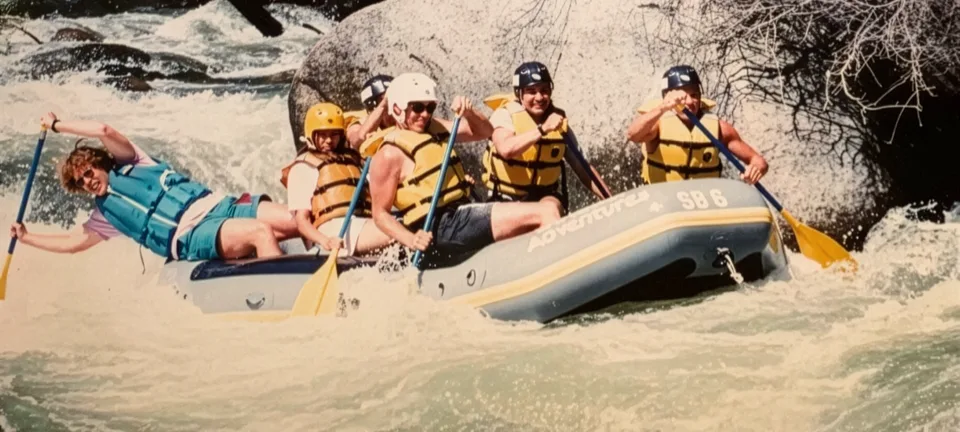
Bishop, who was certified to guide trips on the Class 5 rapids — the most difficult on the Kern — became part of California whitewater rafting lore when he took an oar to the mouth on one trip, shattering seven teeth.
“It was the second day of a three-day trip, so I couldn’t just stop (and get medical care),” he said, with a chuckle. “So, one of the unnamed rapids, ‘Bridgework,’ was named after me.”
Last summer, as he contemplated full-time residence in a mountain community near the Grapevine, he winced at the word “retirement.” Only 67, he preferred to think he is just taking a little break. He is not without hobbies, after all. He loves to read — doesn’t own a TV — and is comfortable in the kitchen; he does all the cooking when he’s home and bakes breads obsessively. His wife, Jacqueline, a geologist from Morocco, is eager to travel and introduce him to her homeland. And there are many more river miles to raft and backpacking adventures to enjoy with his daughter, Katherine, an engineer in Boston.
But that voice in his head, that tug on his sleeve, kept pulling him toward the next something. “Even my wife believes I still need a challenge,” he said, “and we have all sorts of environmental issues out there.”
Hence, the ocean hero returns, rested and restless, and ready to write another Water Boards chapter.