
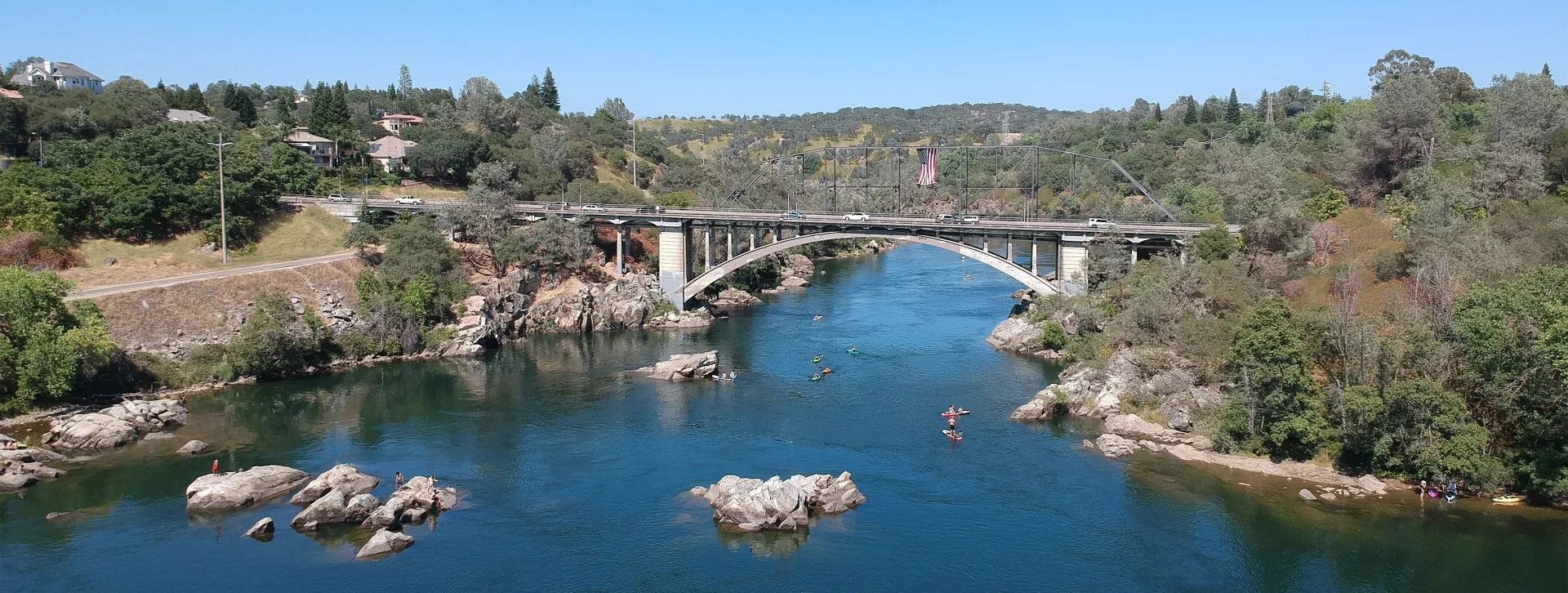
On a summer Sunday, Lake Natoma in Sacramento County is anything but quiet.
Paddleboarders dot the water beneath the bridges. Kayaks crowd the launch at Black Miners Bar, a California State Parks day-use area. Swimmers cool off along the rocky shoreline while families settle in for a day beside the water.
Two mornings later, the scene is different.
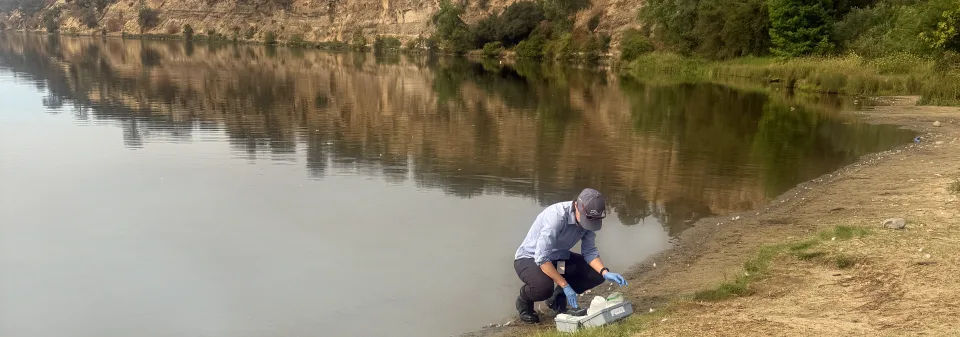
Before much of the day’s recreation begins, Central Valley Regional Water Quality Control Board Engineering Geologist Alisha Wenzel and Environmental Scientist Matthew Krause are already at the water’s edge with sample bottles, field equipment, a clipboard and a cooler.
They are there to collect information that helps address a question people ask them surprisingly often:
Is it safe to swim today?
The answer is rarely as simple as yes or no.
“We are excited this year that people are actually learning about our monitoring and paying attention to the results so they can make informed decisions about recreating.”
— Alisha Wenzel, Central Valley Regional Water Quality Control Board Engineering Geologist
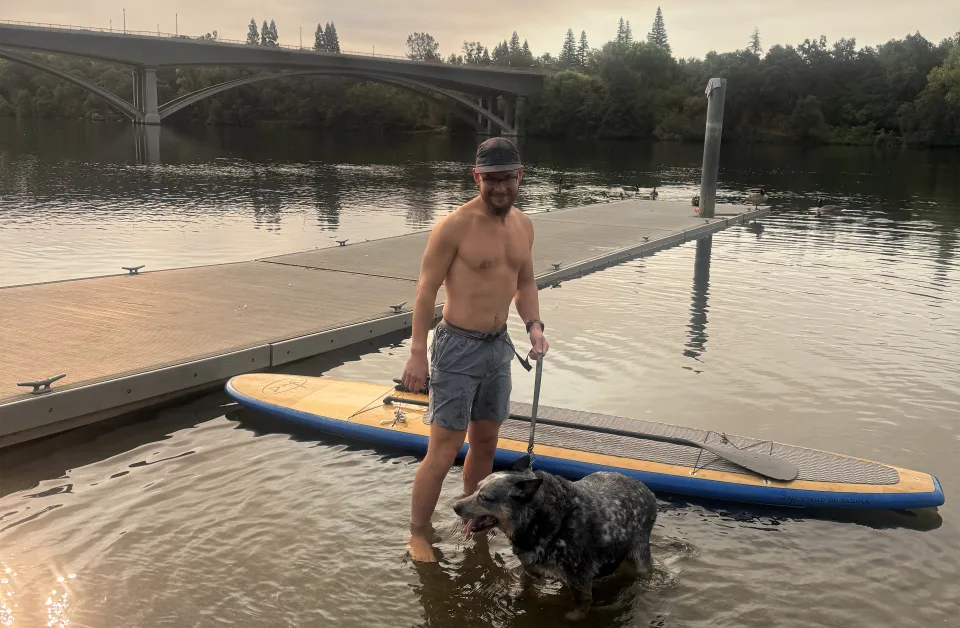
Several paddleboarders stopped to ask about water quality as the scientists worked. One of them, David, paddles Lake Natoma regularly with his dog, Rocky. He follows water quality reports and, if bacteria levels are elevated, may still paddle, but Rocky stays home as a precaution.
Upstream at Folsom Lake, a reservoir on the American River northeast of Sacramento, groups of triathletes gather for open-water swim training.
They are among the people Wenzel and Krause have in mind every time they fill another sample bottle.
Reaching a new audience
The scientists’ work is part of the Central Valley Water Board’s Surface Water Ambient Monitoring Program (SWAMP).
Recreational bacteria monitoring began in 2007 after staff recognized a lack of data about waters where people swim and recreate. For years, much of the monitoring focused on sites along the American and Sacramento rivers.
Newer sampling locations at Lake Natoma and Folsom Lake are attracting considerable public attention. On warm summer weekends, thousands of people swim, paddle, kayak, boat and train in the two lakes, putting board scientists face-to-face with people who use their data.
From lake to lab
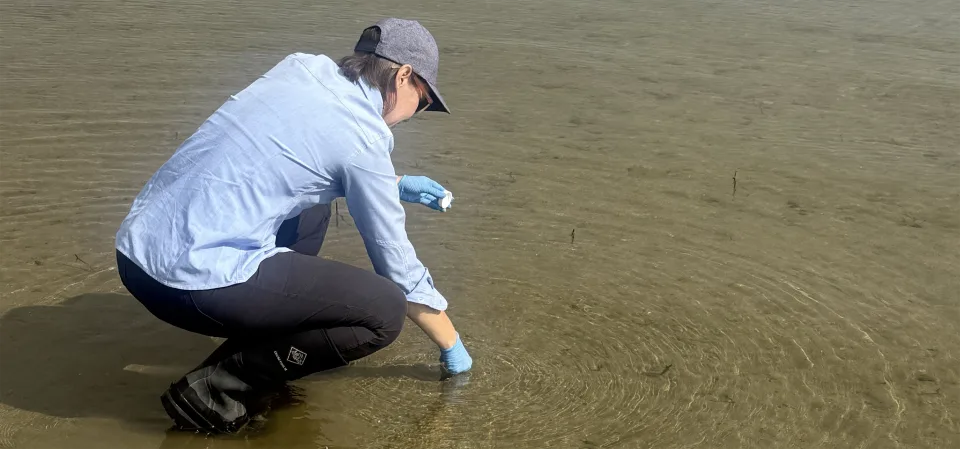
At each site, Krause lowers an instrument into the water to measure conductivity, temperature, pH and dissolved oxygen. Results and other observations are recorded on a field sheet. Wenzel takes three turbidity (cloudiness) readings to measure particulates in the water before collecting the bacteria sample.
Using a sterile bottle and working carefully to avoid contamination, Wenzel collects the sample, seals it and places it in a cooler for transport to the board laboratory.
The samples incubate for about 20 hours before staff can read the E. coli results.
By day’s end, Wenzel and Krause visited 11 sites across the lakes.
“We don’t want to scare people unnecessarily, but we want them to make informed decisions. One of the things we want people to know is that the E. coli we are monitoring for is not pathogenic and is not the primary pathogen we’re concerned about.”
— Alisha Wenzel
Why track E. coli?
One of the most important things Wenzel wants people to understand is that the E. coli being measured is generally not itself the pathogen that makes swimmers sick. Most E. coli is harmless and normally present in the digestive systems of warm-blooded animals.
But research used to establish recreational water quality objectives found that elevated E. coli concentrations correlated with increased reports of swimming-related illness. That’s because E. coli is a reliable indicator of fecal contamination, which can carry other bacteria, viruses and germs capable of causing illness.
Bacteria levels can change swiftly, dramatically
A sample represents one place at one moment.
Bacteria levels can change significantly between sampling events, and even between locations relatively close together. Wildlife, changing water levels and other environmental conditions can influence what a sample captures.
“We can’t monitor everywhere, and this is just a point in time,” Wenzel said. “Conditions are going to change a lot and it’s always good to be aware of that risk and take precautions.”
That uncertainty is also why scientists resist drawing conclusions about the source of bacteria without evidence. Although wildlife is abundant at Lake Natoma, the lake has not undergone the microbial source-tracking studies needed to determine where its bacteria originate.
“As a regulatory agency, it behooves us to make evidence-based statements,” Wenzel said.
Expanding monitoring efforts inland
California’s popular coastal beaches are routinely monitored by a coordinated network of public health agencies, but that isn’t always the case for inland areas such as lakes, rivers and creeks.
With finite staffing and funding — and a short window for processing E. coli samples — Water Boards staff can’t monitor all of the state’s recreational waters. However, as required by statute, state agencies are currently working to expand the kind of monitoring done at the Sacramento-area lakes and Lake Tahoe to other popular inland beaches across the state. Research is underway to determine which waterbodies will be tested in the future and for what indicators.
Helping people make informed decisions
SWAMP staff don’t certify that a lake is simply “safe” or “unsafe.” They provide data that public health officials, land managers and recreationists can use to evaluate conditions and make decisions.
SWAMP coordinates with California State Parks and county health officials, who agree to post advisories when E. coli results exceed 320 MPN (most probable number) per 100 milliliters. Advisories remain until two consecutive samples fall below that threshold.
The latest preliminary results show how that information is used. During the Aug. 4 sampling, no sites at Lake Natoma or Folsom Lake exceeded the short-term statistical threshold. After two consecutive sampling events below that threshold, a swim advisory at Salmon Falls Raft Take-out could be lifted, leaving no active advisories at either lake at that time. The results remain subject to final review.
For Wenzel and Krause, the purpose remains the same whether the numbers are high or low: provide reliable information, explain what it means and be clear about what it can’t tell people.
On weekends, Lake Natoma will again fill with paddleboards, kayaks and swimmers. Triathletes will gather at Folsom Lake for open-water training. David will check the latest information before deciding whether Rocky comes along.
Most will never see Wenzel and Krause at work.
But increasingly, they’re paying attention to what the scientists find.